Calculus Third Edition
PDF files should be printed before use.

7.3.4How do I draw a slope field?
Slope Fields with Parallel Tangents
GRAPHS OF DIFFERENTIAL EQUATIONS
Theresa (who does not know how to integrate) is studying the differential equation 
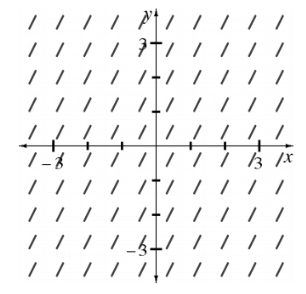
Theresa starts to sketch tiny tangent lines for
. She is very careful to draw them with the correct slope. Examine her sketch. Why do all of the tangent lines have the same slope at ? Obtain a Lesson 7.3.4 Resource Page and complete the graph. Draw small tangent lines through every point for
. This type of graph is referred to as a slope field. Theresa starts jumping with joy. “My slope field reveals that that the antiderivative of
is !” she exclaims. Use differentiation to explain how she knows this. Theresa is ecstatic because there are so many “solutions” to the differential equation. What does she mean by solution? How many are there?
Theresa wonders about the solution that goes through her favorite point,
. How many solutions go through her favorite point? Sketch these “particular solutions".
Theresa is not done. She wonders about other slope fields. On the resource page, sketch slope fields for the following differential equations.
Compare and contrast it to the slope field in problem 7-137. Explain this relationship.
Compare and contrast this slope field to the other two you have done.
Be sure to calculate the slope at each point with the appropriate- and -values at each point.
Theresa wonders if she can solve a differential equation that has two variables. For example, consider the differential equation
On your resource page, sketch a slope field for
. Trace a few particular solutions. What do the solutions look like? Mathematicians use slope fields to help them see the solution to differential equations that are difficult to solve. Try solving
by using implicit integration. Is it possible to separate the variables?
USING SLOPE FIELDS TO GRAPH SOLUTIONS
Solve the following differential equations.
The slope fields for the differential equations in part (a) are shown below. On your resource page, label each slope field with its differential equation and general solution. Then sketch at least two particular solutions on each slope field.
.png)
.png)
For each of the slope fields above, the tangents appear to be parallel at each
-value. Why do you think this is? Look at the differential equations to help guide your answer.
Steady Stephanie draws her slope fields so slowly that it is hard for her to finish her assignment. Complete the following steps on your resource page. A graphing calculator program or computer simulator can speed up the process.
Roughly sketch each of the slope fields
Draw at least two solutions.
Solve the differential equation and compare the results
Each team member should be prepared to share the results of the graphs they explored with the other members of the team.
Roberto drew the slope fields below but forgot to label them with their differential equations. His teammates, Minh and Arak, decide to help him out, but they are not sure how to proceed. They do know that the differential equations are:
.png)
.png)
.png)
.png)
Arak suggests using implicit integration to solve each differential equation and find a match. Explain Arak’s method.
Minh says, “All you have to do is pick a few coordinate points and substitute them into the differential equation.” Explain Minh’s method.
Roberto thinks that his friends’ methods will take too much time. “All you have to do is look at the orientation of the parallel tangent lines!” says Roberto. Explain Roberto’s method.
Use any method to label each slope field with its differential equation.
Explain why graph D does not have parallel tangent lines.

Study the slope field for
What type of functions are
and ? Sketch the particular solution of
through the point on your own set of axes.
.png)
Rewrite each integral using a
Write the equation of a line tangent to the graph of
Use the tangent line to approximate the value of
. Is your approximation an overestimate or an underestimate? Use the second derivative to justify your answer.

Calculate the area between the curves
Multiple Choice: The total area enclosed between the graphs of